
In the last 12 months or so of the pandemic, companies have launched applications on the fly just so they could continue operating: booking and tracking deliveries, contactless payments, online retail, and more. The world changed overnight, and management suddenly had to monitor COVID-19 symptoms, distribute medical equipment, and manage employee wellness remotely. Many of the apps that were released in the last year didn’t even exist in our imaginations, much less in app stores.
Organizations could not afford to take years — even months — to develop these applications, not if they were determined to succeed in the harsh economic conditions. Low-code enabled them to build fast and iterate often.
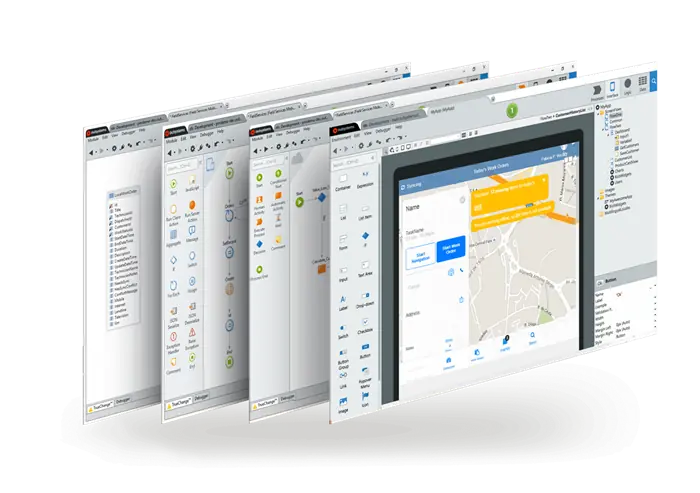 At the heart of a low-code platform is a drag-and-drop interface that your developers can use instead of writing a million lines of code. The forerunning and Gartner-recognized leader OutSystems has the following and more:
What is low-code?
Low-code is a software development approach that enables app delivery fast and with minimal hand-coding. Applications are built through visual development using modeling and a graphical interface. Because manual coding is no longer necessary, you can take apps to production and into the hands of your users much, much faster. Gartner forecasts that 65% of application development will leverage low-code by 2024. In about the same timeline, the low-code industry will triple in value. This is not a surprise since a 2018 Forrester study said that half of developers were already using or planning to incorporate low-code into their initiatives. The COVID-19 global crisis simply accelerated this earlier prediction.What’s in a low-code platform?
At the heart of a low-code platform is a drag-and-drop interface that your developers can use instead of writing a million lines of code. The forerunning and Gartner-recognized leader OutSystems has the following and more:
- Visual integrated development environment (IDE) where developers will visually define the user interface, workflows, and data models of the application. Only if necessary, hand-written code may be added here.
- Backend and services connectors that will automatically handle data structures, storage, and retrieval.
- Application lifecycle manager which are automated tools for building, debugging, deploying, and maintaining the application in test, staging, and production.